Thursday, November 12, 2026
 

Future Computing

10:00 Opening Remarks by Session Chair
  Jörg Stephan, Project Manager & Research Coordinator, Fraunhofer

Jörg Stephan

Jörg Stephan
Project Manager & Research Coordinator
Fraunhofer

Biography
Coming Soon

10:05 Reserved for European Economics
10:15
Energy-efficient electronics at the edge: what the EIC is funding, and why
  Michael J. Bojdys, Programme Manager, European Innovation Council and SMEs Executive Agency (EISMEA)
Energy-efficient electronics at the edge: what the EIC is funding, and why
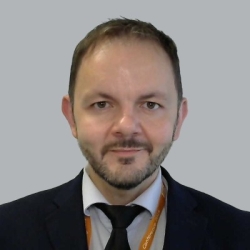

Michael J. Bojdys

Michael J. Bojdys
Programme Manager
European Innovation Council and SMEs Executive Agency (EISMEA)

Michael J. Bojdys

Abstract
Computing at the edge is limited by energy rather than by transistor count. The EIC’s EffiTronics challenge funds six projects that tackle this from different directions: new materials and devices, alternative computing architectures, and ways to harvest and manage energy locally. The talk gives a short introduction to the EIC and its Programme Manager model, then sets out where energy-efficient edge electronics is heading and what the six projects work on. It closes with how start-ups, research organisations and industry can engage with the portfolio and with EIC funding.

Biography
Michael J. Bojdys is Programme Manager for Future-Proof Electronics at the European Innovation Council (EIC), within EISMEA, where he guides portfolios of breakthrough projects in energy-efficient and responsible electronics towards industry and investment. He previously led research groups in functional nanomaterials in Czechia, the United Kingdom and Germany, founded the deep-tech spin-out MANA.energy, and directed multi-stakeholder R&D partnerships in materials acceleration between academia, industry and government across Germany, Canada, the United Kingdom and Switzerland. He sat on DIN standards committees for rare earths and non-ferrous metals and contributed to ISO 24181-1, and was a member of the World Economic Forum’s Young Scientists community.

10:35
Building quantum computers atom by atom


  Davide Dreon, Head of Product Development, PlanQC GmbH
Building quantum computers atom by atom
Davide Dreon

Davide Dreon
Head of Product Development
PlanQC GmbH

Davide Dreon

Abstract
PlanQC’s quantum computers store information in individual atoms - nature’s best qubits. Quantum information is processed by arranging these qubits in highly scalable arrays and manipulating them with precisely controlled laser pulses. PlanQC’s unique combination of quantum technologies is the fastest way to scale to thousands of qubits, a prerequisite for industry-relevant quantum advantage. Our quantum computers are built on the precision of the world’s best atomic clocks, the world’s best quantum gas microscopes, and high-speed Rydberg gates. PlanQC is the first startup to emerge from the Munich Quantum Valley, which with its vast network of research institutes and industrial partners fosters a unique quantum ecosystem for startups.

Biography
Davide Dreon is Head of Product Development at planqc, working on building and developing neutral atom quantum computers. An experimental physicist by training, he completed his PhD at the Laboratoire Kastler Brossel on highly magnetic quantum gases, and later conducted research at ETH Zurich on Bose-Einstein condensates coupled to optical cavity modes. Before joining planqc, he was Research Fellow and Head of R&D setups at Pasqal.

10:55
Next-Generation Optical Switching and AI Infrastructure
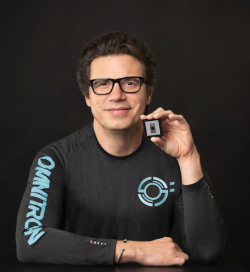

  Keith Eric Aguilar, CEO, Omnitron Sensors
Next-Generation Optical Switching and AI Infrastructure
Keith Eric Aguilar

Keith Eric Aguilar
CEO
Omnitron Sensors

Keith Eric Aguilar

Abstract
The rapid growth of AI is creating new requirements for high-bandwidth, energy-efficient connectivity and placing increasing pressure on conventional electrical network architectures. Optical circuit switching offers a path toward more scalable infrastructure, but achieving the required optical performance, reliability, and manufacturability presents significant MEMS design and fabrication challenges.Omnitron is addressing these challenges through a proprietary 3D MEMS fabrication platform and large-aperture mirror arrays with in-situ feedback control. The technology enables high-performance optical switching while supporting flatter network topologies, lower interconnect power consumption, and reduced infrastructure cost. This presentation will explore the MEMS innovations behind the platform and how advanced microfabrication can enable a new generation of optical switching systems for AI infrastructure.

Biography
Eric Aguilar is the CEO and co-founder of Omnitron Sensors, where he leads the development of next-generation MEMS technologies for AI infrastructure and autonomous systems. His career spans more than two decades in advanced sensing and semiconductor innovation, including leadership roles at Google X, where he led avionics development for autonomous delivery drones, and Tesla, where he led firmware and sensor integration for Model 3. Earlier in his career, Eric developed advanced sensors for U.S. Navy research laboratories and defense programs before joining Lumedyne, whose technology was later acquired by Google. Today, he leads Omnitron’s commercialization of breakthrough MEMS technology designed to enable the next generation of optical networking for hyperscale AI data centers.

11:10 Reserved
11:30 CLosing Remarks by Session Chair
  Jörg Stephan, Project Manager & Research Coordinator, Fraunhofer
Jörg Stephan

Jörg Stephan
Project Manager & Research Coordinator
Fraunhofer

Biography
Coming Soon